
Back

MentorLIVE #91: Teaching AOA Basics

Earn WINGS Credit What is WINGS?

NAFI MentorLIVE logoMore from NAFI MentorLIVE · Episode 91

Proudly sponsored by Avemco Insurance Company

Mike Vaccaro of the FlyONSPEED team explains how to teach angle of attack: AOA as an energy instrument, calibration, the military's on-speed concept, aural tones, stall margins, and power and coordination in turns.

How to earn WINGS credit ↓

Read more in About this course ↓

Chapters & program details from mentorlive.site

Chapters 8
About This Course

TEACHING AOA BASICS - The AOA Can Be The Best, Most Intuitive Energy Instrument In The Cockpit!

Orville Wright patented the first commercial AOA system in 1913. The military has been using Angle of Attack (AOA) successfully for over a half century to teach pilots how to “fly the wing” and manage energy. The FAA recently encouraged the installation of AOA systems in GA aircraft as a means to reduce loss of control mishaps, the primary cause of fatal mishaps in our community, that has remained stubbornly consistent since the NTSB data base was established in 1962-63

As AOA systems become commonplace in General Aviation, flight instructors can benefit from lessons learned in other flying communities. Depending on design, a properly calibrated AOA system is the only instrument in the cockpit that provides “how hard the wing is working right now” information to the pilot, including key performance parameters. And all AOA systems when properly calibrated

While airspeed is a key energy parameter, the speed at which an airplane stall varies constantly with weight and g-load, whereas critical AOA does not. A key concept is a parameter the military calls “on speed,” or the AOA used for approach and landing and maneuvering flight—a term that rightly blends the concept of airspeed and AOA, since AOA and power control airspeed.

This brief focuses on how pilots apply AOA, not engineering concepts; and how AOA can be the best, most intuitive “energy” instrument in the cockpit. In addition to discussing AOA instrumentation, this brief will also discuss a simple, intuitive aural cue developed by the Air Force to allow the pilot to listen to how hard the wing is working, freeing up eyes for other duty.

Presenters

Mike “Vac” Vaccaro

Presenter

Mike Vaccaro, FlyONSPEED.org MIKE "VAC" VACCARO - Presenter

Mike is part of the FlyONSPEED team, a non-profit flight research and engineering design group dedicated to reducing loss of control risk in EAB and GA. The team was selected as the first-place winner of the EAA’s Founder’s Innovation Award Prize in 2018, and Grand Champion in 2021 for their work. The team designs hardware conducts flight test and produces education resources for the Experimental Amateur Built community.

He is a retired USAF Lt. Colonel, F-4/F-15 pilot, Fighter Weapons School instructor, test pilot, commander and veteran of three combat deployments. He started flight instructing in GA in 1983 and is a current CFII/ME and airline pilot. He flies a specially instrumented experimental RV-4 for testing angle of attack, energy management systems and the TLAR decision app from his home airport, Ruckel Field (FL17) 5 miles east of Eglin AFB in the Florida Panhandle, where he lives with his wife Theresa.
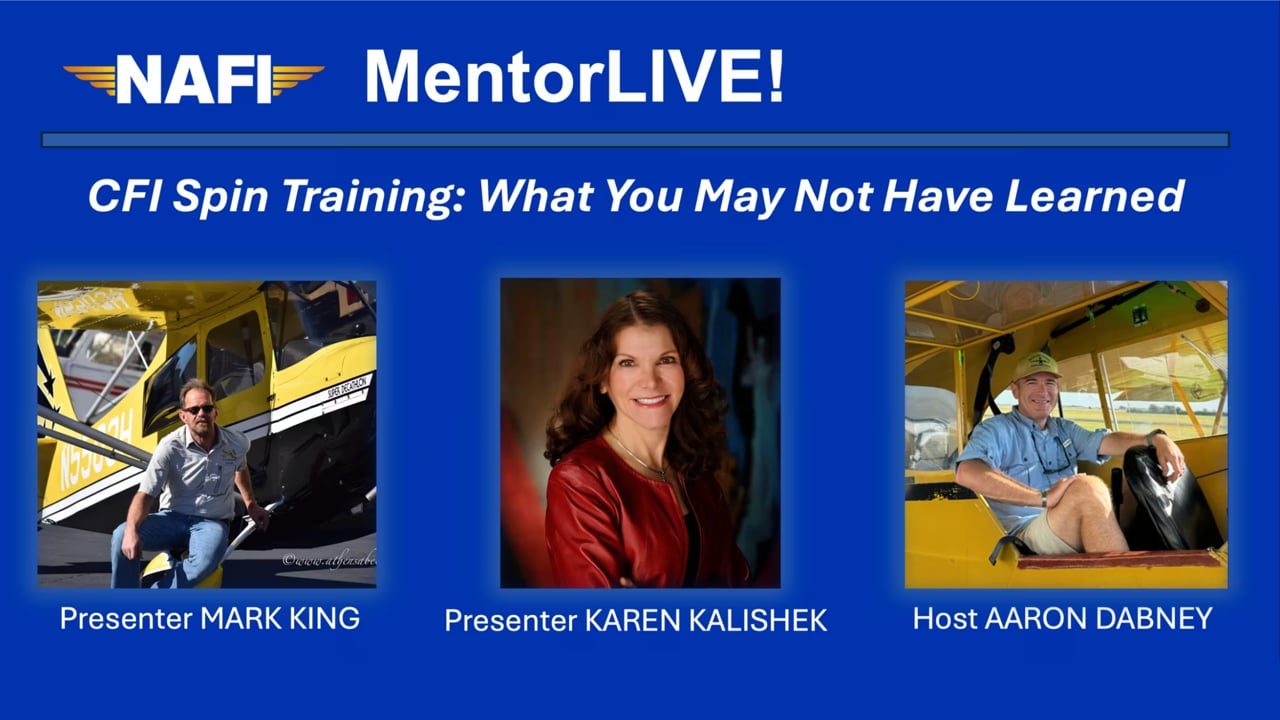
Karen Kalishek

Host

Karen is the NAFI Board Chair, a Designated Pilot Examiner, three-time NAFI

Master Instructor, CFI, CFII, MEI, CFI-G, AGI, IGI, FAA Gold Seal Instructor and

FAASTeam Lead Representative. She teaches in a range of aircraft and enjoys

flying her own RV6.

Karen is a Major in the Civil Air Patrol (CAP), serves as a member of the WINGS

Industry Network, contributes to the FAA Surface Safety Group, is an FAA Safety

Team Lead Representative, and is active in several other aviation organizations.

Karen is the 2019 National FAASTeam Representative of the year.

She became active in aviation after success as a senior VP in the banking

sector, as a graduate school professor, and as President of her own

international consulting business.

WINGS Credit Details
Earn WINGS Credit FAASafety.gov course ID: 1407

Log in to your FAASafety.gov account, take the course quiz and receive WINGS credit.

Content above is from the original episode page: https://mentorlive.site/program/91.html/

Related programs